

Setting the right on-page SEO strategy before you write your blog post is key to helping your overall website ranking. Getting your website/blog to show up on page 1 of Google is achieved in part by properly structuring each of your posts to contribute to the rest of your website’s SEO plan.
Here are seven key elements you want to have well thought out before you hit that “publish” button on your post:
- Keyword Research- Without a doubt, one of your first considerations as you sketch out your content if you are writing with the intent to have your post be found online. Optimizing your keywords (Very different approach than keyword stuffing which is a NO-NO)
will help make sure that the people that are looking for info on your topic can find it. As a publisher, unless you are writing for posterity, you probably want the right people to find your post as it is likely that you have a bigger goal in mind.. like connecting with future clients, building a tribe to help you grow your business, etc.
You can use tools like Google’s Keyword Planner to come up with the most common searched terms related to your topic. Pick short phrases as well as long tail phrases to make sure you have a proper balance and variety that is natural in a well research, well written piece. - Permalinks- Within WordPress, your permalinks should always be properly set to show the title of your post, not the default setting of page/post number which does nothing for your on-page SEO. This is probably fundamental, but of such importance that it is worth mentioning.
- Titles- Your post title has two important functions, in no particular order: Draw your reader’s attention to find out more, and get the search engines to index your post properly. You have to balance between writing for your reader and writing for the search engines. You can achieve both without compromising either. Let’s say you have a blog about mortgage information. A recent new lending change took place in Dec 2014 that allows borrowers to buy a home with only 3% down, instead of the previous minimum which was 5%, or with FHA which was 3%.
Looking at keyword research we find that “First Time Home Buyer” has 2,400 monthly searches, more than any related keyword. We also find related, long tail key-phrases that we will use within our post.
Some headlines we could use would be: (you write down several so you can choose the one that best suits your post later)
– First Time Home Buyers will find relief in new loan programs
– New 3% down payment will help thousands of First Time Home Buyers buy a home
– First Time Home Buyers will find getting into a home a lot more affordable now!
These titles cater specifically to what home buyers are looking for online, information on how to buy a home with small down payments. The title also gives the search engines a term to index and tie to your post that gets thousands of searches every month. ‘tis a win-win. - Content – it’s been said over and over, and we will say it again. Content in king when it comes to engaging your readers. You write for your readers first.. then for the search engines. Your content must be properly formatted, and optimized for easy reading by your audience. Some suggested steps are:
– Be direct, clear, concise. For the most part, blogging is not about getting wordy and using five dollar words, unless that is precisely what your audience is looking for, which is rare.
– Write short sentences, and short paragraphs.
– Break up content and use bullets, lists, block quotes, white space and any other trick you can come up with to make your content easily scanable and readable.
– Use action words. - Make use of H2 and H3 tags – they help emphasize portions of your content AND help highlight keywords that are relevant for your SEO efforts.
- Include links to internal and external resource– share information that your readers may find helpful. This will show your audience that you are not trying to manipulate them to stay all within your website, and that you are well connected with other people and resources online.
- Use categories and tags – these help organize your content within your blog/website. Categories are like cabinets in a file drawer. Tags are the folders in the drawer.
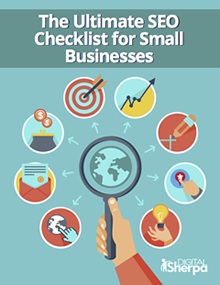
Marketing Sherpa has a great resource; A FREE ebook titled: “The Ultimate SEO Checklist for Small Business Websites”. You may want to take a thorough
look at that for more in-depth information on how to implement the concept of SEO for your small business.
Structuring your posts properly for maximum on-page SEO effectiveness, siloing your content to properly organize your website/blog, and always using the highest quality content you can produce, will give you a huge advantage over your competition since the majority of small business owners, consultants and sole practitioners simply will not take the time to do this. It is not an easy task, but with practice and some determination, you can do it and will be rewarded for your efforts with more and better quality readers who are loyal and engaged with your brand/business.

